
Sleep Apnea
Does Insurance or Medicare Cover a Sleep Apnea Mouthguard?
Why oral appliances are billed to medical insurance, and what Medicare usually needs.
3 min readBy Hiral Desai, DDS, MDS, D. ABDSM
CPAP works very well for sleep apnea, but only if you can wear it. If the mask, noise or hose keeps you from using it, a custom oral appliance may be an option. Here is how the two compare, from a dentist who is a Diplomate of the American Board of Dental Sleep Medicine.
The short answer
CPAP is the most effective treatment for severe sleep apnea, but many people struggle to wear it. A custom oral appliance holds the lower jaw forward to keep the airway open, and is a recognised option for mild to moderate sleep apnea and for people who can't tolerate CPAP. Your sleep physician and dentist decide together.
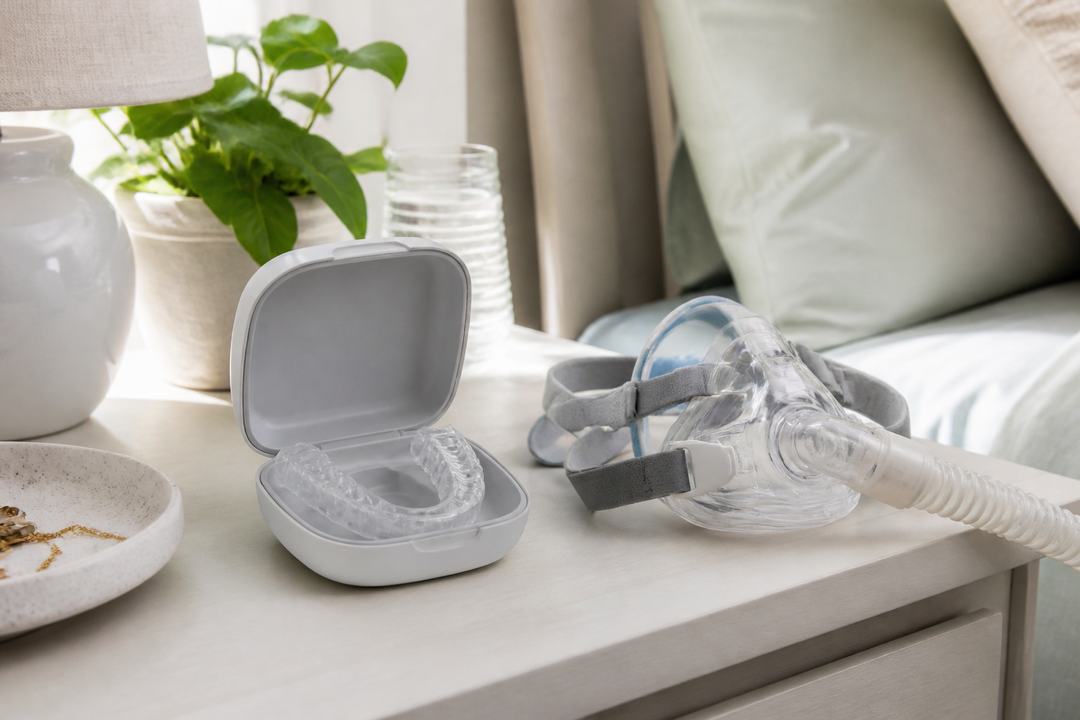
Both keep your airway open while you sleep, in different ways.
A machine blows gently pressurized air through a mask, which keeps the throat from collapsing. It is the most effective treatment for many people with sleep apnea, especially severe cases.
A custom mouthpiece, similar to a sports guard, holds the lower jaw slightly forward. That keeps the tongue and soft tissue from blocking the airway. The American Academy of Sleep Medicine supports oral appliances for adults with mild to moderate obstructive sleep apnea and for patients with severe obstructive sleep apnea who can't tolerate CPAP or prefer another option.
| CPAP | Oral appliance | |
|---|---|---|
| Comfort | Mask and hose take getting used to | Small mouthpiece, no mask |
| Travel | Machine, power and supplies | Fits in a small case |
| Noise | Quiet hum from the machine | Silent |
| Upkeep | Clean mask, hose and water tank | Brush and rinse daily |
| Effectiveness | Most effective, especially for severe sleep apnea | Effective for many mild to moderate cases and severe CPAP-intolerant cases |
Your sleep physician and Dr. Desai decide together what is right for you.
Struggling with CPAP? Book a sleep consultation with Dr. Desai.
Book a consultationIt usually takes a few visits.
You need a diagnosis first. If you haven't had a study, we can refer you for a home sleep test or an in-lab study.
Impressions or a digital scan of your teeth are used to make a custom appliance that is FDA-cleared and PDAC-verified.
The appliance is adjusted in small steps to find the position that keeps your airway open comfortably.
A follow-up test confirms the appliance is working. We coordinate with your physician on the results.
Some patients use CPAP at home and an oral appliance when traveling or camping. Others use both together if their physician recommends it. Patients with severe sleep apnea can benefit from an oral appliance as combination therapy, which allows lower CPAP pressures and makes CPAP more tolerable.
Most are mild and settle as you get used to it.
Possible in the first weeks, usually easing in the morning soon after you take it out. Simple jaw exercises we recommend will help overcome any jaw soreness.
Bite changes are more likely if you have loose teeth or gum disease. Good oral hygiene, regular checkups and cleanings help keep your bite stable.
Often temporary while you adjust. Read Can Dry Mouth Be a Sign of Sleep Apnea?.
Sleep apnea care is provided through SnoozX-AI, our dedicated sleep apnea center, here at Larwin Square in Tustin. Patients come from Irvine, City of Orange, Santa Ana and the rest of Orange County. We're open Monday to Wednesday and Friday from 9:00 AM to 5:30 PM, and every Saturday from 8:00 AM to 2:30 PM. Call (714) 505-9462 or book online.
Yes. Sleep apnea must be diagnosed by a sleep physician. We can refer you for a home or in-lab test.
Several years with good care. We check it at your regular visits.
Yes. All our oral appliances come with a 2 to 3 year warranty. Ask our team for more warranty information.
Dr. Desai mainly provides SomnoMed and ProSomnus oral appliances. Every device we use is custom-made, FDA-cleared and PDAC-verified.
For many people it reduces snoring a lot. A sleep test confirms whether your sleep apnea is controlled.
Yes. We accept all PPO medical insurance plans and Medicare. If you have HMO insurance, let our front desk know and they will check whether it is covered under your plan. See our coverage guide.
Yes. It fits in a small case and needs no power.
Some people notice a difference within days. It can take a few weeks of adjustments to find the best position.
Dr. Desai is a Diplomate of the American Board of Dental Sleep Medicine and works alongside your physician. A consultation is the first step to finding out whether an appliance suits you.
Sources: AASM and AADSM clinical practice guideline on oral appliance therapy (J Clin Sleep Med, 2015) · NHLBI: What Is Sleep Apnea?
Why oral appliances are billed to medical insurance, and what Medicare usually needs.
Loud snoring, dry mouth or grinding? The warning signs and when to get tested.
What implant surgery feels like, sedation options, and a day-by-day recovery timeline.
This guide is general information, not a diagnosis. Book a visit for advice about your own teeth.